
By Brenda Mazhambe
The Rural Electrification Agency (REA) has completed preparations for the commissioning of the Mbuyamaswa-Kwamutevhure electrification project, with the official switch-on ceremony scheduled for tomorrow, Friday 25, September 2026.
The project, which is part of Government’s drive to expand access to modern energy in rural Zimbabwe, is expected to bring electricity to key social and economic institutions serving communities in the area.
Speaking at Kwamutevhure High School ahead of the commissioning ceremony, REA Public Relations and Marketing Executive Mr Johannes Nyamayedenga said preparations for the programme were complete, paving the way for the official energisation of the project by the Minister of Energy and Power Development, Hon July Moyo.
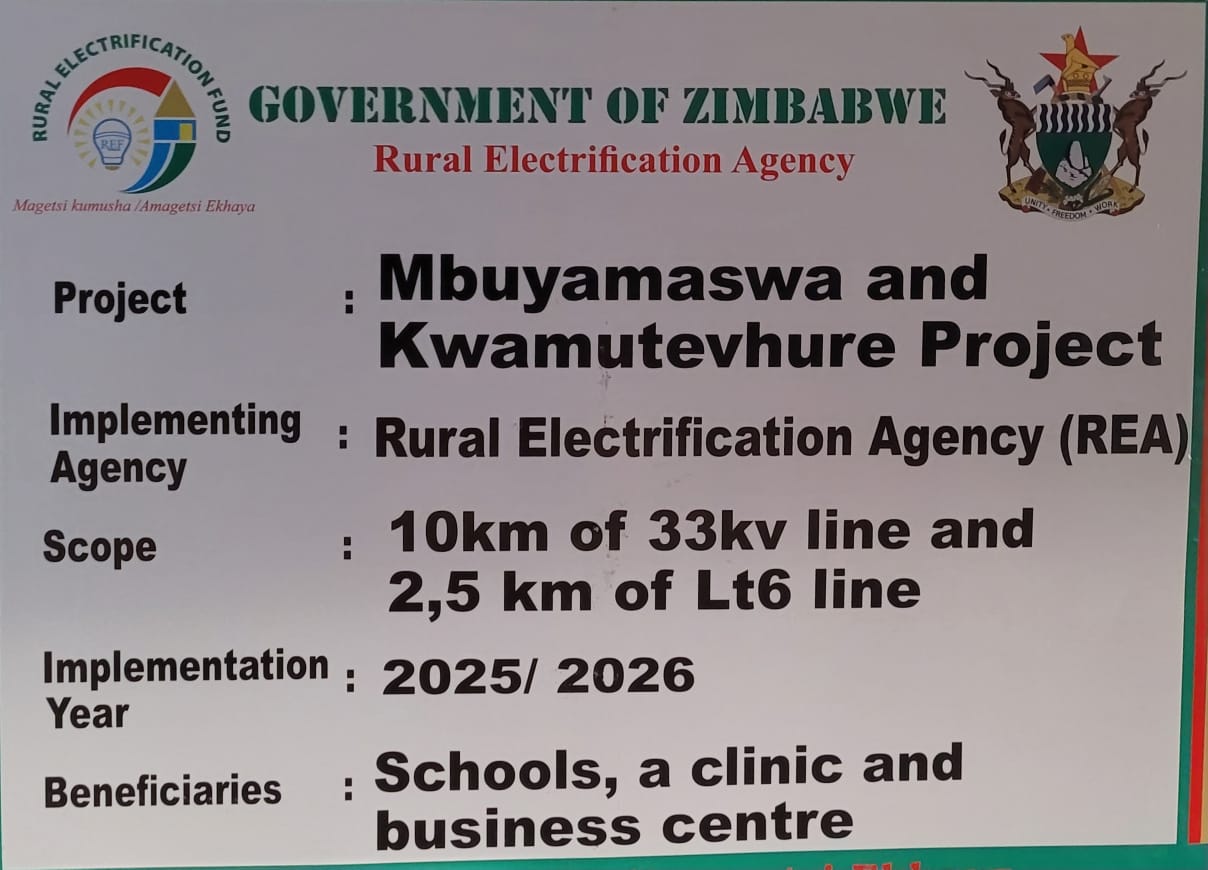
Implemented during the 2025/2026 period, the project comprises 10 kilometres of 33kV power line and 2.5 kilometres of L16 line.
Mr Nyamayedenga said all the necessary arrangements had been put in place for the switch-on programme.
“Everything is now ready for the commissioning and switch-on programme. We are satisfied with the preparations on the ground and look forward to officially bringing electricity to the targeted institutions and the surrounding community,” said Mr Nyamayedenga.
The electrification programme is expected to benefit Mbuyamaswa Primary School, Kwamutevhure High School, Mbuyamaswa Clinic and the Mbuyamaswa Business Centre.
Beyond simply providing lighting, rural electrification is regarded as an important driver of socio-economic development. Electricity enables schools to improve learning conditions and use computers and other technologies, while clinics can operate essential equipment, improve service delivery and provide better conditions for patients and health workers.
For rural businesses, reliable electricity can support refrigeration, welding, milling, charging services, irrigation, retail operations and other income-generating activities. It can therefore create opportunities for small enterprises, employment and increased household incomes.
REA says its national mandate is to facilitate rapid and equitable electrification of rural Zimbabwe through the conventional grid as well as renewable energy technologies such as solar and biogas. Its stated target is universal access to sustainable modern energy services by rural communities by 2030, with the agency indicating that all rural public institutions, households and farming communities should have access to one form of modern energy or another by that year.
The target feeds directly into the country’s Vision 2030 agenda. Government’s Vision 2030 framework originally set a target of increasing rural household electricity access from 27.7 percent in 2017 to 60 percent by 2030, alongside broader improvements in infrastructure, education, health and economic empowerment.
More recent national electrification planning has set an even broader ambition of universal electricity access by 2030, using a combination of grid expansion, densification, standalone solar systems and mini-grids. The National Energy Compact projects electricity access rising from 41 percent in 2024 to 100 percent by 2030.
The Ministry of Energy and Power Development describes rural electrification as a major pillar of socio-economic development, while REA’s programme covers schools, clinics, government offices, farms, business centres, homesteads and irrigation schemes.
The Mbuyamaswa-Kwamutevhure project therefore represents more than the installation of power infrastructure. Its connection of education, health and business facilities illustrates the broader objective of using energy access to unlock economic activity and improve the quality of public services in rural communities.
With Zimbabwe working towards universal modern energy access by 2030, projects such as Mbuyamaswa-Kwamutevhure form part of the wider effort to close the rural-urban development gap and ensure that rural communities participate more fully in the country’s economic transformation.