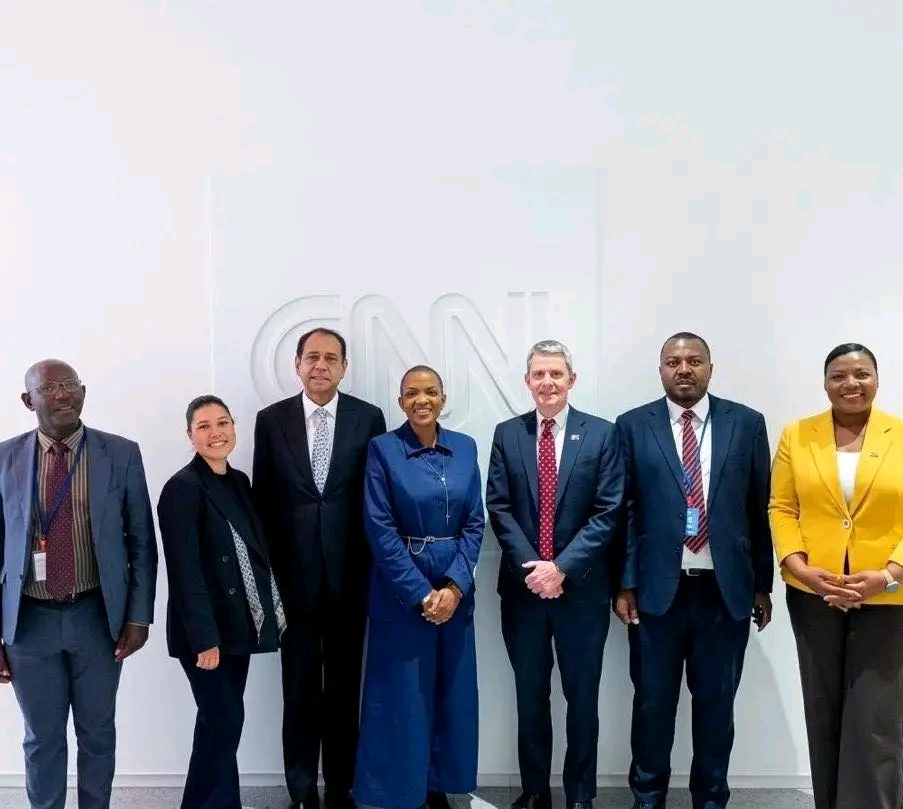
Zimbabwe’s Tourism Minister Hon Barbara Rwodzi poses for a photo with CNN officials in New York recently on the sidelines of the United Nations General Assembly
By Dickson Bandera
Zimbabwe is seeking to turn international attention on its tourism sector into greater destination visibility, tourist arrivals and investment through a proposed strategic media partnership with CNN, as the country intensifies efforts to market itself to high-value international audiences.
The proposed engagement was discussed in New York on the sidelines of the 81st United Nations General Assembly, where Tourism and Hospitality Industry Minister Barbara Rwodzi and Zimbabwe Tourism Authority (ZTA) chief executive Dr George Manyaya met senior CNN executives, including CNN International vice-president Phil Wilson, CNN sales director Zara Driss and CNN regional representative for Africa and Central Asia Imran Ahmad.
The discussions place international media at the centre of Zimbabwe’s broader tourism and investment marketing strategy, with the proposed CNN partnership expected to promote the country not only as a leisure destination but also as an investment market across the tourism value chain.
The opportunity comes at a time when Zimbabwe is seeking to increase the economic value derived from its tourism assets, including wildlife, heritage, adventure tourism, hospitality, meetings and conferences, and emerging investment opportunities.
CNN is particularly relevant to that strategy because its commercial division has a dedicated tourism and destination-marketing capability.
CNN International Commercial says its TASK division — Tourism, Advertising, Solutions and Knowledge — works with more than 100 nations on tourism and development communications. Its services include destination-brand strategy, brand creation, global intelligence, stakeholder engagement and bespoke workshops. CNN also markets travel solutions across television, digital and social platforms.
The network’s commercial operation has also demonstrated how destination campaigns can be constructed around more than conventional advertising. In a case study on Mongolia, CNN Create produced television commercials, interview films, social content and a dedicated digital content hub incorporating an interactive map of tourism and business opportunities. The campaign was distributed through CNN’s digital and social channels to traveller and investor audiences.
For Zimbabwe, such an approach could allow the country to tell a more complete destination story — moving beyond Victoria Falls to wildlife, heritage, culture, adventure, gastronomy and tourism investment.
A country with more than Victoria Falls
Victoria Falls remains Zimbabwe’s most recognisable international tourism asset.
The Mosi-oa-Tunya/Victoria Falls World Heritage property extends across Zimbabwe and Zambia, with the Zimbabwean component including Victoria Falls National Park and part of Zambezi National Park. UNESCO describes the waterfall as the world’s greatest sheet of falling water, extending about 1,708 metres across the Zambezi and falling through a series of basalt gorges.
But the falls are only one component of the country’s tourism proposition.
Zimbabwe has five properties inscribed on the UNESCO World Heritage List: Great Zimbabwe National Monument, Khami Ruins National Monument, Matobo Hills, Mana Pools National Park together with the Sapi and Chewore Safari Areas, and Mosi-oa-Tunya/Victoria Falls.
Great Zimbabwe offers a particularly strong heritage proposition. Built between the 11th and 15th centuries, the stone-built settlement covers almost 800 hectares and was an important trading centre. Archaeological evidence found at the site includes Chinese and Persian ceramics, glass beads and gold and Arab coins associated with the wider Indian Ocean trading system.
The site also gives Zimbabwe an unusually powerful national symbol for international storytelling: the Zimbabwe Bird, carved from soapstone and associated with the country’s historical identity. UNESCO notes that the steatite bird has been adopted as Zimbabwe’s national emblem.
The Matobo Hills provide another combination of landscape, wildlife and living cultural heritage. The World Heritage site contains dramatic granite formations, archaeological evidence of human occupation and one of the highest concentrations of rock art in southern Africa, with paintings dating back at least 13,000 years.
A major wildlife and birding proposition
Zimbabwe’s wildlife story also provides material for international travel programming.
Hwange National Park, the country’s largest national park at about 14,650 square kilometres, is described by the Zimbabwe Parks and Wildlife Management Authority as the home of the country’s largest elephant population. The park supports four of Africa’s Big Five — elephant, lion, leopard and buffalo — together with about 100 mammal species and nearly 400 bird species. It is also recognised for rare species including roan, sable and wild dog.
Mana Pools provides a different safari proposition. Situated along the Zambezi, the World Heritage property is known for large concentrations of elephants, buffalo, leopard and cheetah, as well as Nile crocodiles. The wider property covers about 676,600 hectares.
ZimParks lists about 380 bird species at Mana Pools, while Hwange has nearly 400. At Victoria Falls, a recent UNESCO conservation document records more than 415 bird species, including resident and migratory species, and identifies the gorges as an Important Bird Area. At least 13 raptor species breed in the gorges.
That gives Zimbabwe an opportunity to market itself not merely as a conventional safari destination but as a birding, wilderness and photographic tourism destination.
Among the species associated with the Victoria Falls ecosystem are the Taita falcon and black eagle, while the broader Zimbabwean landscape supports a wide range of raptors, waterbirds, woodland species and migratory birds.
What CNN can bring to the proposition
The potential value of CNN lies in its ability to combine international news, travel storytelling, business coverage, digital distribution and social media.
CNN’s travel programming has previously included Quest’s World of Wonder, in which Richard Quest travelled to destinations and explored their history, people, culture and identity. The programme was accompanied by digital material on CNN Travel and social media.
CNN continues to develop travel and culture programming. Its 2026 programming includes Seasons, covering global trends in areas including travel, food, design and culture, while new travel programming such as K-Everything uses a host-led format to connect tourism with culture and global consumer interest.
The network is also expanding its Africa-focused programming. In August 2026, CNN International launched Africa Inc., a multiplatform series hosted by Nigerian journalist Adefemi Akinsanya and focused on African companies, hospitality, technology, manufacturing and entertainment. Akinsanya is based in Lagos, giving the programme an Africa-based reporting presence. Segments are distributed across CNN International, digital and social platforms.
That creates an interesting potential intersection for Zimbabwe: the country’s tourism story can be presented not only as a travel proposition but as part of Africa’s wider business, investment and economic transformation narrative.
CNN’s commercial operation says its audience data identifies international travellers and investors as distinct audience groups, while its travel offering is designed for tourist boards and travel brands across television, digital and social platforms.
The network also has extensive distribution beyond conventional television. CNN International Commercial says CNN International content is available in approximately three million hotel rooms worldwide and on hundreds of commercial aircraft, while its content-syndication operation serves airlines, hotels, cruise ships and other out-of-home platforms.
For Zimbabwe, therefore, the CNN opportunity could potentially involve several layers — destination advertising, branded films, digital storytelling, social-media distribution, travel programming and business-focused content.
Tourism as an investment proposition
The country’s tourism authorities are also attempting to sell Zimbabwe as an investment destination. At the Zimbabwe Business Forum in New York, Dr Manyaya reportedly presented the country’s tourism proposition through the “Six A’s” — attractions, accessibility, accommodation, amenities, activities and ancillary services.
He also highlighted the Masuwe Special Economic Zone near Victoria Falls, a 1,200-hectare development intended to accommodate tourism and financial-services investment.
This investment narrative could complement the destination-marketing component of a CNN partnership.
The objective would be to show international audiences that Zimbabwe’s tourism proposition extends from the attraction itself to accommodation, transport, conferencing, restaurants, adventure activities, conservation, retail and supporting infrastructure.
Such an approach would also allow tourism marketing to address two markets simultaneously: people who may travel to Zimbabwe and businesses that may invest in serving those travellers.
The proposed engagement therefore comes at an important point in Zimbabwe’s attempt to reposition its tourism story internationally.
The country already possesses globally recognised natural and cultural assets. The challenge is converting recognition into measurable economic activity — more international visitors, longer stays, higher visitor spending, wider geographical distribution of tourism and new investment.
A CNN partnership, if concluded and structured effectively, would give Zimbabwe access to a global storytelling and distribution platform capable of presenting those assets through multiple formats.
The central question will be what story Zimbabwe chooses to tell.
Victoria Falls can provide the opening image. Hwange can provide the wildlife. Mana Pools can provide wilderness. Great Zimbabwe can provide history. Matobo can provide landscape and living heritage. Zimbabwe’s birdlife can provide a specialist tourism proposition.
The larger story is a country attempting to package all of these experiences — together with hospitality, investment and culture — into a destination proposition capable of competing for attention in a crowded global tourism market.